| |
|
|
|
|
|
|
|
|
|
|
|
|
|
 |
|
|
|
|
Clayfest 2017, 12-17th June, Lincoln Castle, Lincoln, UK.
BOOKING IS THROUGH OUR PARTNERS THE HERITAGE SKILLS CENTRE, PLEASE CLICK
HERE
Hello Earth Building enthusiasts, and welcome to this year’s EBUKI
Festival and Conference in Lincoln. Our theme explores the relationships
between Earth Building and other materials, construction and design and
training, thinking about building bridges through knowledge, skills,
research and training.
Following the last year’s tremendous success in Scotland and Cumbria, we
were delighted to be holding 2017’s workshops, from 12th to 17th June, at
the beautiful Lincoln Castle in their Heritage Skills Centre. This central
location not only brims with life, but also LOTS of the local earth
vernacular ‘Mud and Stud’ and clay mortared stonework.
This year we want to combine teaching core skills at beginners, semi-skilled
and skilled levels with a spirit of curiosity and invention. Earth building
is having a renaissance with people trying many new ways to work with some
of the oldest materials and techniques. From the structural to aesthetic,
thermal properties to colour we hope to encourage and show that earth in
buildings can exceed all expectations. Last year saw the second only ever
rammed earth vault, the year before the first turf wall in Scotland in a
very long time. This year what will it be?, stoves that heat and cook by
burning straw, industrial clay and hemp and some clay and lime magic…
Last year Clayfest got a lot of great feedback, most people rated it as very
good or excellent, 80% said they would recommend Clayfest to others. It’s a
chance to try things out with a group of experts working together, asking
and answering questions over four days, the UK’s biggest earth building
event…
For more about the workshops and leaders please see
here
Conference
Conference this year continues with the theme of Clayfest, building
bridges. How do we respect tradition, learn from tradition, for more details click here
Symposium
This years symposium is on the local
vernacular, mud and stud, for details please see
here Tour
There will be tours of old and new, experimental and traditional, housing
and public buildings, for more on tours please see
here
Booking Tickets
BOOKING IS THROUGH OUR PARTNERS THE HERITAGE SKILLS CENTRE, PLEASE CLICK
HERE
Staying
Lincoln has many different types of place to stay to suit most pockets.
We will publish details on the camping option we favour shortly.
|
|
|
|
|
|
|
|
Clayfest Workshops and Leaders
|
|
| |
|
|
| |
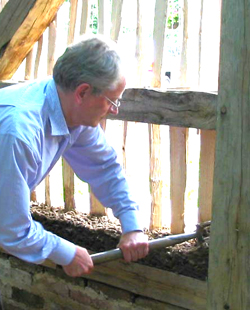
Light-Earth
Construction; Clay and Natural Fibre Composites.
William Stanwix,
Monday to Thursday June 12th 2017. |
|
|
|
|
| |
|
| |
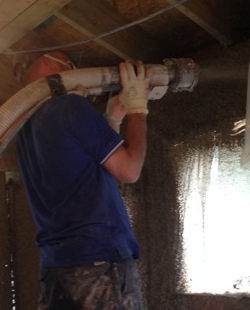
This workshop demonstrates the versatility of spray machines and
the range of possibilities for clay/fibre spray applied coatings
and monolithic walls. It also demonstrates the possibilities for
insulating light-earth blocks and load bearing earth blocks for
use in mainstream construction.
Will Stanwix is a natural building enthusiast. Will has worked
in the construction industry as surveyor, contractor and project
manager. He is most well known for starting the Hempcrete
building company; Hemp-LimeConstruct (now UK Hempcrete) and
co-authoring 'The Hempcrete Book’. Will has now taken a break
from contracting and joined HG Matthews to look at ways to
develop clay, straw and hemp based materials for the more
mainstream building industry in the form of un-fired blocks.
Will is working with Grahame Durrant of Hemp-lime Spray to
explore the potential for spray applied coatings composed of
clay and natural fibre.
|
|
|
|
|
| |
|
|
| |
Earth, earth-lime
and hot mixed lime mortars - hidden in plain sight.
Nigel Copsey, Monday to Thursday
June 12th 2017. |
|
|
|
|
| |
|
| |
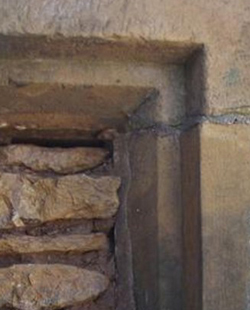
'Earth and earth-lime mortars were the common mortar of masonry
construction across the UK, Ireland, Europe and the Americas until the
end of the 18thC, in association with hot mixed lime pointing and finish
coat or render mortars. This course will look at historic precedent and
numerous examples of this widespread pattern of construction and will
discuss its demand for compatible repair and conservation and explore
the materials and methods necessary to achieve this'.
Starting out as a dry-stone waller in Cornwall, Nigel trained
after 1989 as stonemason and carver, working largely in
conservation across the south of England, and in Vermont, USA,
as well as in Granada, Andalusia. Nigel was consultant
stonemason for the Irish Hunger Memorial project in Battery Park
City, New York, 2001. Since 2001, Nigel has worked extensively
as consultant and practitioner in the field of building
conservation and repair in North Yorkshire upon a wide range of
vernacular and high status buildings, as building conservation
consultant for the Fitzwilliam Estate in Malton, designing,
specifying and executing major repair projects to a wide range
of historic buildings within the town, as well as researching, |
|
|
|
|
|
designing and specifying a number of building repair and conservation
projects on behalf of Natural England, most recently at Scampston Hall.
Nigel has contributed to several volumes of the recently published
Historic England Practical Conservation series. A Research Associate of
the Dept of Archaeology, York University, Nigel regularly delivers hot
mixed earth and lime mortars and traditional skills training and leads
the Practical Skills module for the MA Conservation Studies.
|
| |
|
|
| |
The Steppe Oven: Food Without Wood
Maria Brown and Rowland Keable,
Monday to Thursday June 12th 2017. |
|
|
|
|
| |
|
| |
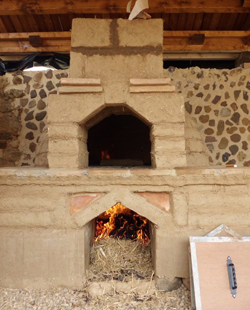
This forsaken device, an ingenious hybrid of mud oven and Roman
hypocaust, comes to you from the Spanish castellan steppe to warm up
your shared tasteful dinners using only mud and straw, as it was for
centuries in its tree-free birth land. Stepped into in: that’s what
ESTEPA Association did a decade ago, developing this model we are
spreading around in three continents. Permanent equipment in public
areas, community centres and schools, it stands in rural and urban
Europe, Latin America and Africa, witnessing new applications and
swallowing unexpected fuels.
We hope this itinerant workshop will combine intercultural
sharing, technical training and building of public equipment. Languages
(EN-FR-ES), ages and professions are mixed and trainees are encouraged
to skip the script in a twin track participative learning. In plus,
bringing this oven to life develop many earth building skills in a short
time by using different techniques –adobe and rammed earth in this case.
And then many hours of cooking remain ahead… So come and join us!
|
|
|
|
|
| |
|
María Brown, architect, founder and president of ESTEPA
Association (Spain). 30 buildings with local materials, mainly
earth; 25 years programme designer/trainer in earth building,
energy and safe habitat. Nomad by nature, after long-term living
and working in 16 towns/cities of 7 countries of 3 continents
she’s actually based in Senegal as a director of gender-based
development programmes.
|
| |
|
|
| |
Earth and Fibre;
Experiments with Forms and Finishes.
Becky Little and Tom Morton,
Monday to Wednesday, June 12th 2017. |
|
|
|
| |
|
| |
This workshop will experiment and play with earth and natural
fibres to creatively explore surface and form. We will use a
range of soils, mixes and building techniques to construct
several small structures. The emphasis will be on the artistic
and sculptural potential of earth in combination with other
natural materials including straw, hemp, aggregates, fabrics and
small dimension timber. The workshop is for all levels of
experience and will give you the opportunity to learn from our
experience through your individual interests.
Becky and Tom have been building with earth and fibre in
Scotland for over 20 years: Becky as a mud mason carrying out
repair of historic mud buildings and new earth structures and
Tom as an architect designing and managing earth projects. They
also carry out materials research and have spent the last few
years building and sculpting their own home using a wide range
of techniques including mudwall, mud blocks, clay mortar and
stone, mud and stud, wattle and daub, earth furniture, earth
floors and decorative earth plasters. They have a wide knowledge
of Scottish earth traditions and have travelled to gain wider
earth building experience in Arizona, Denmark, Devon, Iceland,
Iran and Burkina Faso. |
|
|
|
|
|
| |
|
|
| |
Mud and Stud,
Lincolnshire Heritage Technology for the Future
Rob Ley and Trevor Oliver,
Monday to Thursday, June 12th 2017. |
|
|
|
| |
|
| |
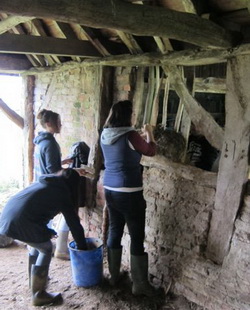
Mud and Stud, a vernacular form of wattle and daub, comprises a
mixture of earth, clay, straw and water being in-filled within a
lightweight timber frame with laths and traditionally having a
thatched roof. It is peculiar to Lincolnshire, and versions of
it can be found all round the world. Such buildings have links
to Tennyson through the village of Somersby in the Lincolnshire
Wolds, and Jamestown, the first permanent English settlement in
the Americas. Trevor Oliver and Rob
Ley will be leading a hands-on workshop which can be joined for
either one or more days over a four-day period, building a
sizeable scaled down model of a Mud and Stud structure. A brick plinth
will have a pre-fabricated timber
frame with openings and pre-fabricated roof. They will
introduce the basics of Mud and Stud, the concept and
tradition of the building form. Rob will show and demonstrate
the elements and methods that make and form the timber framing
with vertical riven ash laths and together with Trevor will lead
into the earth with clay material selection, mixing with straw,
sand and water and application within the timber framing to the
laths using the ‘daubing’ technique. Attention will be paid to
the treatment and technical detailing with junction of the
‘earth material mix’ with other materials such as the plinth and
openings.
|
|
|
|
|
| |
|
|
| |
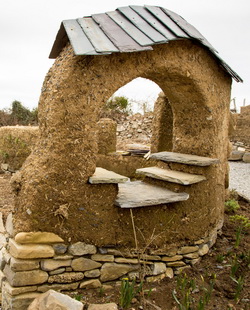
Cob Workshop,
Basics to Mobius Strip.
Colin Ritchie and Féile Butler,
Monday to Thursday June 12th 2017. |
|
|
|
| |
|
| |
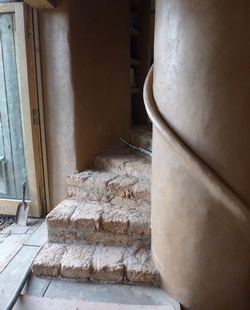
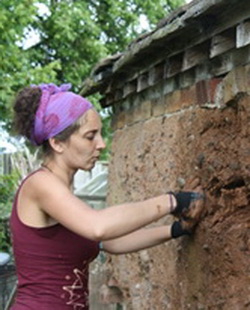
Day 1 of four days of workshops will concentrate on the basics
of cob – material selection, methods of mixing, building by hand
and exploring cob’s sculptural potential. Over the following 3
days we will teach practical cob building skills through the
construction of an earthen “mobius strip”. As well as looking at
techniques for scaling up cob, we will look at forming arches
using both wet cob and cob blocks. We will also look at how to
incorporate different types of timber elements.
Between 2008 and 2010, Colin Ritchie and Féile Butler designed
and built their own contemporary cob home. Two years later they
founded Mud and Wood, an award-winning company providing advice,
architectural and building services, and practical training for
natural building projects. Over the past five years, they have
taught private workshops for numerous community and student
groups, as well as hosting dozens of courses at the Mud and Wood
House. |
|
|
|
|
| |
|
|
| |
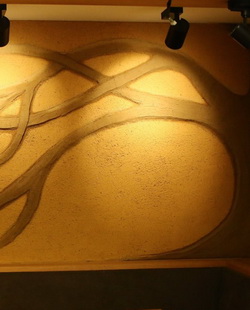
Earth Plasters,
Decoration, Colour and Textures.
Peter Coch Shaman and Nyja Maya,
Monday to Thursday June 12th 2017.
|
|
|
|
| |
|
| |
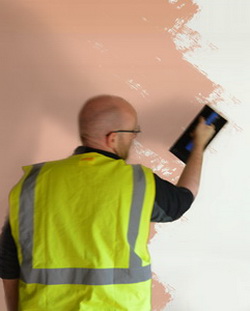
Day 1 of four days of workshops will concentrate on not just the basics
of plasters but also on colour, texture, decoration and fun...
Peter and Nyja ... |
|
|
|
|
|
|
|
|
|
|
|
|
BOOKING IS THROUGH OUR PARTNERS THE HERITAGE SKILLS CENTRE, PLEASE CLICK
HERE
|
|
|
|
|
Conference
Conference this year continues with the theme of Clayfest, building bridges.
How do we respect tradition, learn from tradition, teach tradition, adapt
tradition to bring a new generation of builders, designers, developers and
clients to a better understanding and respect for materials which have
almost perfect credentials in the circular economy, cradle to cradle
materials which can be used and re-used almost indefinitely.
Earth as a material has powerful properties and yet what people too often
think of are it’s weaknesses. Other building materials also have weaknesses
but have been more successful in projecting their strengths, what can we
learn from this and how do we project that knowledge and understanding?
Hearing from speakers working in and out of the earth building world we will
plot a course to better understanding, better networks, building bridges to
better building. |
|
|
|
|
Speakers
|
|
|
|
|
| |
|
|
| |
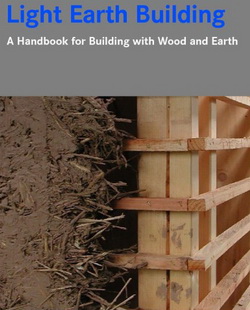
Light-Earth
Building.
Franz Volhard
Friday June 16th 2017. |
|
|
|
|
| |
|
| |
Light earth: an amazing building material, but completely
unknown. Today the renewable surplus of wood has led to the
Renaissance of wood-frame construction, and we can go back again
to the old tradition of the earth formwork in the modern form of
wooden skeleton and frame construction. The big advantage
compared with load-bearing construction methods: earthen
construction works can be built under the weatherproof
protection of the roof. Earth is adaptable and is the ideal
partner for wood because of its drainage qualities. With
thermal-insulating light earth, all structural elements –
exterior and interior walls, ceilings and roof – can be filled
in in a non-load bearing way. The desired thermal insulation or
heat storage are controlled through the proportion of earth and
straw mixed together. Uncomplicated production with simple hand
tools or machine support promised a quick and cost-effective
implementation, even in professional applications.
Franz Volhard
(born in 1948 in Frankfurt/Main) is a partner of Schauer +
Volhard architects (BDA) in Darmstadt. Since 1980, he has
designed and built numerous light earth projects, many of which
have won architecture prizes and awards. His |
|
|
|
|
|
extensive
research has given rise to new techniques of using light earth for
contemporary applications in sustainable building with wood and earth.
He teaches and consults internationally and has lectured and published
widely, including co-authoring the Lehmbau Regeln, the German earth
building codes. He is member of CRAterre, the International Center for
Earthen Architecture in France, and a founder member of the Dachverband
Lehm, the German Association for Building with Earth.
|
|
|
|
|
|
|
|
|
| |
Clay? An Innovative
Material for the Future?
Dan Maskell, Friday June 16th 2017, |
|
|
|
|
| |
|
| |
Are modern low carbon buildings detrimental to our health?
Modern buildings have been developed to be very airtight,
improving their energy efficiency and reducing their carbon
footprint. However, these sealed environments have created
unexpected side effects, with research showing that a build-up
of potentially harmful chemicals in the air is potentially
causing negative impacts on occupants.
Dan will present the
findings of a European Union project titled ECO-SEE which has
used clay plasters to regulate the indoor environment quality.
The project has been running for 3.5 years and brought together
18 partners from across Europe. His research bridges the
quantitative measurements behind the qualitative experience of
living within an earthen home. |
|
|
|
|
|
Daniel is is a Research Associate at the Univeristy of Bath
working on the ECO-SEE project. His passion for earth
construction is mainly within the new build sector; which is
fostered by his PhD work. It is his belief that mainstream
adoption of earthen construction can utilise the environmental
benefits on a wider scale and have a significant and measurable
impact. This approach has become the rationale for his current
research and will become key to his planned future work in
academia.
|
|
| |
|
|
| |
Making earth a
conventional building material.
Louise Halestrap,
Friday June 16th 2017. |
|
|
|
|
| |
|
| |
Louise will explore the relationship of The Centre of
Alternative technology (CAT) and Earth. She will show how CAT
allows future professionals in building, policy and
sustainability to fully appreciate the credentials of materials.
She will explain how critical thinking and practical exploration
are key to fighting green wash and understanding carbon
footprint whilst increasing breathability and health within the
built environment. She will give a brief outline of how CAT keep
students excited about sustainability after they leave CAT and
show some data on the influence CAT alumni have in taking
natural materials into the main stream.
Louise is a senior lecturer at the Centre for Alternative
Technology’s Graduate School of the Environment. She focusses on
adaptation planning, water security and practical sustainable
building. She is especially interested in ‘normalising’ low
carbon materials and debunking greenwash. |
|
|
|
|
| |
|
|
| |
Analysis and
documentation of the historic use of earth materials in Scotland
and general overview on Bruce Walker collection.
Maria Saez-Martinez
Friday June 16th 2017. |
|
|
|
|
| |
|
| |
Maria will talk about her research survey on the remained earth
buildings, or places where the element earth as a construction
material was crucial and widely used in Scotland’s past. One of
the main resources for documentary evidence for her research is
the extensive inherited collection of Bruce Walker by historic
environment Scotland, as Bruce’s main field of research for many
years had been vernacular buildings and clay traditional uses in
construction mainly in Scotland. She will give us an overview of
the content of his archive.
Maria is a Spanish trained Building Engineer. Her early career
specialised in earth materials and intervention in disasters,
researching at Civil Engineering School in Portugalon, analysing
the mechanical properties of adobe bricks during earthquakes. At
Edinburgh in 2013 for a Beng (HONS) Energy and Environmental
Engineering focusing on energy efficiency, thermal mass and
solar space heating for new design as well as old/historic
buildings. After completing her MSc Architectural Conservation
at Edinburgh University in 2016, she works for Historic
Environment Scotland on Documentation and Analysis of the
history and use of Earth Materials in Scotland. She is
passionate about heritage and its conservation, earth materials,
energy efficiency and sustainable design. |
|
|
|
|
|
|
|
|
|
| |
Building Bridges Through Marketing, Changing Perceptions of Earth Building
Through Communication.
Rowland Keable, Friday June 16th 2017, |
|
|
|
|
| |
|
| |
Rowland will show how marketing can be done easily and cheaply
by earth builders, changing market perceptions and personal
practice.
|
|
|
|
|
|
|
|
|
BOOKING IS THROUGH OUR PARTNERS THE HERITAGE SKILLS CENTRE, PLEASE CLICK
HERE
|
|
|
|
|
Symposium
|
|
|
|
|
|
As we have in the past we will run a day’s symposium on the local
vernacular, mud and stud. This is a chance for builders, conservers,
residents, planners, regulators, academics, architects to come together and
review the ‘state of the art’. Speakers will have the chance to exchange
views on traditional techniques, modern design standards, compare materials,
learn from each other. This will happen in a room at the Heritage Skills
Centre on Thursday 15th in the Clayfest week.
|
|
|
|
|
Speakers
|
|
| |
|
|
| |
Mud and Stud Conservation.
David Glew, Thursday June 15th 2017. |
|
|
|
|
| |
|
| |
More details to follow |
|
|
|
| |
|
|
| |
Mud and Stud,
Practical Considerations.
Rob Ley, Thursday June 15th 2017. |
|
|
|
|
| |
|
| |
More details to follow |
|
|
|
| |
|
|
| |
Models for Building
Conservation: Mud and Stud.
Kathryn Banfield,
Thursday June 15th 2017. |
|
|
|
|
| |
|
| |
More details to follow |
|
|
|
| |
|
|
| |
Mud and Stud Conservation.
Naomi Field,
Thursday June 15th 2017. |
|
|
|
|
| |
|
| |
More details to follow |
|
|
|
| |
|
|
| |
Tumby Moorside, a
Model for Mud and Stud Conservation.
Thursday June 15th 2017.
|
|
|
|
|
| |
|
| |
More details to follow |
|
|
|
|
|
|
|
|
BOOKING IS THROUGH OUR PARTNERS THE HERITAGE SKILLS CENTRE, PLEASE CLICK
HERE
|
|
|
|
|
Tour
|
|
|
|
|
|
This year’s tour has old and new, experimental and traditional, housing and
public buildings.
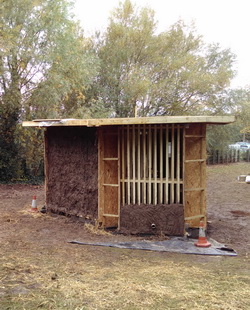
The Hexagonium is an experimental earth building constructed on the Lincoln
University campus by students from the School of Architecture.
It was built as part of an ongoing project to allow experimentation with
materials and construction techniques in preparation for a project to build
a new mud and stud dwelling at the Village Museum in Skegness.
The building has fourteen different panels of mud walls in varying
thicknesses with a variety of insulation materials incorporated into the
mixes in order to test the u/values and different methods of construction.
The construction of the building was carried out by a local specialist
contractor over a period of sixteen days.
A number of groups of architecture
students from Lincoln University worked on its construction, part of the
reasoning behind this was to help enable them to understand the transition
from the drawing board to the actual construction process.
During construction varies methods of applying earth to the walls were
tested, results show that it may be possible to speed up the build process
and thermal properties by introducing clay fired balls, hemp or other
materials into the mix. More tests are planned in the near future.
Once the building has dried sufficiently it will be tested for u/values and
hygrothermal performance.
This building is important in that it will help to provide evidence for the
use of earth as a viable construction material for our future.
The tour will be conducted by Trevor Oliver who led the construction work. |
|
|
|
|
Venues
|
|
| |
|
|
| |
Ailby Ash Holt
Saturday June 17th 2017, |
|
|
|
|
| |
|
| |
A new mud and stud structure at Ailby, near Alford. Built by Rob
Ley, a professional woodworker, specialising in traditional /
Lincolnshire woodworking and building crafts and skills,
including the use of axe and froe tools, splitting wood and
timber - cleaving/riving for example, and with oak frame being
nailed to with ash laths and to which mud wall being applied or
‘daubed’ with a daubing fork or tool, comprising subsoil with
clay mixed with straw and water and mud, clay plaster. And with
brick plinth and pantile roof.
The tour will be conducted by Trevor Oliver who led the construction work.
|
|
|
|
| |
|
|
| |
Hexagonium, Research
into Building Code Acceptance for Mud and Stud
Saturday June 17th 2017, |
|
|
|
|
| |
|
| |
A number of groups of architecture
students from Lincoln University worked on its construction, part of the
reasoning behind this was to help enable them to understand the transition
from the drawing board to the actual construction process.
During construction varies methods of applying earth to the walls were
tested, results show that it may be possible to speed up the build process
and thermal properties by introducing clay fired balls, hemp or other
materials into the mix. More tests are planned in the near future.
Once the building has dried sufficiently it will be tested for u/values and
hygrothermal performance.
This building is important in that it will help to provide evidence for the
use of earth as a viable construction material for our future.
The tour will be conducted by Trevor Oliver who led the construction work.
|
|
|
|
|
| |
|
|
| |
Thimbleby
Saturday June 17th 2017, |
|
|
|
|
| |
|
| |
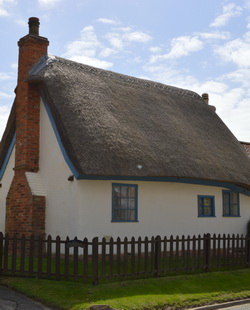
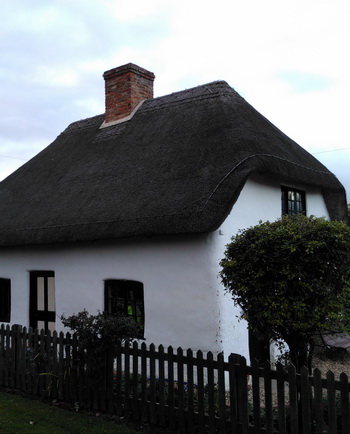
Thimbleby is a small village lying to West of
Horncastle in the Lincolnshire Wolds. It has approximately 50
properties with ten of them being mud and stud and another two
known to have been demolished.
Several of the cottages lie
alongside the main road and are very picturesque as you drive
through the village some with their limewashed walls and
thatched roofs suggesting how the village would have been two or
three hundred years ago.
One or two of the cottages are
thought to date back to the sixteenth century; some retain their
plastered mud walls whilst others are brick encased with pan
tiled roofs demonstrating the progression with building
materials and fashion whilst still displaying their heritage as
timber framed buildings.
Thimbleby is unique, a place where you can experience a
feeling of stepping back in time when you see on either side of
the road a row of vernacular buildings in the Lincolnshire mud
and stud tradition without a modern building in sight to spoil
the experience.
The tour will be conducted by Trevor Oliver, Chairman
of EMESS
|
|
|
|
| |
|
|
| |
Greetham
Farmhouse
Saturday June 17th 2017, |
|
|
|
|
| |
|
| |
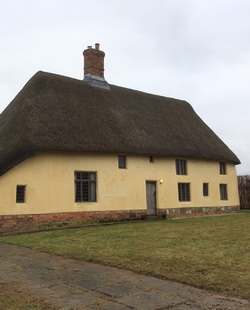
Greetham Farmhouse lies in a small village East of
Horncastle, it is known to be one of eight timber frame mud
buildings in the village, six of them having been demolished.
It is an example of a large 3 bedroom
farmhouse. It is thought to be mid fifteenth century with later
alterations and is grade II listed.
Ii was brick encased
until 1997 when it underwent a full restoration. The restoration
was carried out by local craftsmen under the guidance of John
Hurd who is well known throughout the world for his work with
earth buildings. The craftsmen who worked on the farmhouse all
went on to do work on numerous mud and stud buildings as well as
other earth structures in other counties.
The tour will be conducted by John Hurd.
|
|
|
|
| |
|
|
| |
Whitegate and
Ivy cottages
Saturday June 17th 2017, |
|
|
|
|
| |
|
| |
Whitegate and Ivy cottages are owned by the
National Trust.
Whitegate is a mid-eighteenth century
cottage, grade II listed cottage. It was a typical farm
labourer’s cottage on the edge of the Lincolnshire Wolds. It is
part of the Gunby Hall estate where there is thought to have
been a number of mud and stud cottages. It has recently been
renovated and is in use as a holiday let.
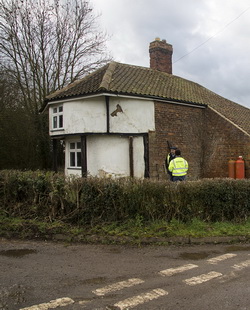
Ivy Cottage is also
part of the Gunby estate, it was tenanted until recently and is
awaiting renovation. It is a brick house with additions in the
nineteenth century. There are a few surviving mud walls and
timber framework with evidence of timber posts.
An unusual
feature is that one end is a half round mud and stud wall with a
jettied first floor. Various features suggest that it was not an
ordinary dwelling but had some, as yet, unknown commercial use,
possibly as a toll house or public house.
Early in 2016 the
National Trust and EMESS worked in partnership holding an
investigation day to try and discover the history and the
elements of the construction of the building.
When a course
of action regarding the future use of the building and details
decided on its renovation it is intended that workshops will be
held through EMESS to allow ‘hands on’ repair of the mud and
stud parts of the building by members of the public.
The tours will be conducted by Brian Hayes Lewin a
building surveyor with the National Trust.
|
|
|
|
| |
|
|
| |
Hill Holt Wood Rammed
Earth Teaching Space
Saturday June 17th 2017, |
|
|
|
|
| |
|
| |
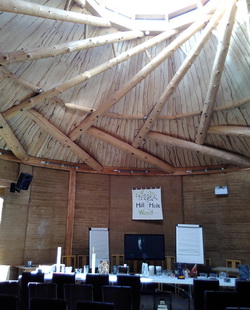
Hill Holt Wood are an exemplary organisation with a slew of
awards in both provision of help and training for young people,
but also in sustainable building. They have been earth building
in different ways on their site for the last 20 years. They are
based in a wood west of Lincoln and the whole site is entirely
‘off grid’ so using things like compost toilets are ‘fitted as
standard’. Their ambitious new build in rammed
earth allowed bigger visitor and learning groups into the
woods and bridged public perceptions of natural building in
interesting ways. It was natural for them to look to the
materials they have on site for their basic building elements,
and to turn the use of those materials into a building course
for their young people.
|
|
|
|
| |
|
|
| |
Withern Cottage
Saturday June 17th 2017, |
|
|
|
|
| |
Withern Cottage is a mud and stud cottage built in the
18th century in the village of Withern North of Alford.
In the early 1980’s the owner had permission to build a new
dwelling and demolish the brick outbuilding standing on the
site. When demolition started the encased mud and stud cottage
was discovered inside the walls of the brick building. Rodney Cousins, curator of The Museum of
Lincolnshire Life, initiated a project to dismantle it and
have it rebuilt at another location.
It was carefully dismantled and rebuilt using as
much of the original material as possible and now stands as an
exhibit at the museum.
It is an important building in that it
raised awareness of, and stands as an example of, our vernacular
and cultural history.It led to a society for people interested in earth buildings, East Midlands Earth
Structure Society [EMESS] being formed to raise awareness, of our local vernacular style of building. Over the
years EMESS has helped many people with earth buildings from
advice on minor repairs to planning applications.
The tour will be conducted by David Glew who is a past
chairman and founder member of EMESS and retired architect who
has worked on many mud and stud buildings.
|
|
|
|
| |
Partners
EBUKI are partnering with three local organisations to make Clayfest
as successful as it can be, they are:
Heritage Skills Centre Lincoln, the location for Clayfest in their
bespoke facility and on the area around it. This is the first Clayfest
to be hosted in an urban environment, we're looking forward to it!
Hill Holt
Wood are a very successful organisation in working with young people
and bringing them into the world of work and jobs. Through their
Growing Up Green program they are able to bring young people to
workshops and make sure they get the most out of them.
East
Midlands Earth Structures Society are a regional earth building
group founded by the visionary Rodney Cousins and currently steered by
Trevor Oliver who not only supports us with local knowledge and
contacts, he is running a mud and stud workshop too...
|
| |
| |
| |
|
BOOKING IS THROUGH OUR PARTNERS THE HERITAGE SKILLS CENTRE, PLEASE CLICK
HERE
|
|
|
|
|
|
|
|
|
|
|
|